Don’t Skip These Ford Maintenance Items: They’re the Ones That Cause Expensive Repairs

Brake Fluid
Transmission Service
Coolant
Cabin Air Filter
Engine Air Filter
Check Engine Light
AC Service
FAQ
Don’t Skip These Ford Maintenance Items: They’re the Ones That Cause Expensive Repairs
Most major repair bills start the same way. Something small gets ignored for a few months, then a few more, and by the time it becomes impossible to ignore it has turned into something that costs ten times what the original service would have. This post covers the maintenance items Biener Ford’s service team sees skipped most often on F-150s, Explorers, and Rangers, what happens when you skip them, and what the warning signs look like before they get expensive.
Brake Fluid
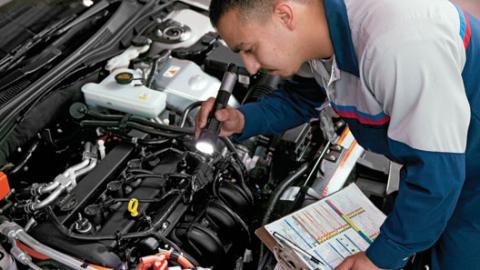
Brake fluid is the most consistently skipped maintenance item on trucks and SUVs, and it is also one of the most consequential to ignore. Most owners do not know it needs to be changed at all. It does.
Brake fluid is hygroscopic, meaning it absorbs moisture from the air over time. As moisture content builds up, the boiling point of the fluid drops. Under hard braking, a truck with degraded fluid can experience brake fade, which is reduced or spongy pedal feel when the brakes need to work hardest. On an F-150 loaded with tools and materials on the LIE, that is not a comfortable situation.
Ford recommends brake fluid service every two years regardless of mileage. Most owners are well past that by the time they think about it. For a full look at how Ford’s service intervals are structured and what the Intelligent Oil-Life Monitor does and does not track, that post covers it in detail.
Signs your brake fluid needs attention:
- Brake pedal feels softer or lower than usual
- Warning light on the instrument cluster
- Spongy or inconsistent pedal feel under repeated braking
- Visible discoloration in the reservoir under the hood (fresh fluid is nearly clear, degraded fluid is dark brown)
Brake fluid service is one of the least expensive items on this list. Ignoring it long enough to damage calipers, the master cylinder, or ABS components is not.
Transmission Service
The 10-speed automatic in the F-150 and Ranger is one of the more sophisticated transmissions on the market. It requires regular fluid service to stay that way. Transmission fluid degrades with heat and use, losing its ability to lubricate and cool the clutch packs and gear sets inside the unit. Degraded fluid accelerates wear and, given enough time, leads to harsh shifts, slipping, and eventual transmission failure.
The 10-speed has a documented history of rough shifting at low speeds, a complaint that surfaces regularly among F-150 owners. In many cases a fluid change addresses or significantly improves these symptoms. In cases where an owner has gone a long time without service, the damage may already be done and a fluid change alone will not fix it.
On an F-150 used for towing or hauling, which puts far more thermal stress on the transmission than normal highway driving, the service interval should be treated as a ceiling rather than a target.
Signs your transmission needs service:
- Harsh or clunky shifts, particularly at low speeds
- Hesitation or hunting between gears
- Slipping under load when accelerating
- Transmission warning light or reduced power message on the cluster
Transmission fluid service costs a fraction of a transmission repair or replacement. On an F-150, that repair is a substantial bill.
Coolant
Coolant keeps the engine from overheating and prevents internal corrosion in the cooling system. Over time, the corrosion inhibitors in the coolant break down and the fluid becomes acidic. Acidic coolant attacks aluminum components, gaskets, and the water pump from the inside, which is why regular coolant service is on every manufacturer’s schedule.
On the Explorer and Ranger specifically, coolant service is an item that tends to get overlooked during routine oil changes because it does not have a mileage-based warning light and does not cause obvious symptoms until the damage is already happening. By the time a radiator or water pump fails, the coolant that should have been changed years earlier has already done its damage.
Ford uses a specific orange or gold long-life coolant in most current models. Mixing coolant types or topping off with the wrong fluid accelerates the problem rather than preventing it.
Signs your coolant needs attention:
- Engine temperature gauge running higher than usual
- Sweet smell from the engine bay or cabin vents
- Visible rust or debris in the coolant reservoir
- Coolant level dropping without an obvious external leak
Cabin Air Filter
The cabin air filter sits behind the dashboard and filters the air coming through the climate control system into the passenger compartment. It is one of the simplest and least expensive services on any Ford, and one of the most consistently skipped.
A clogged cabin filter does two things. It restricts airflow through the vents, which means the AC has to work harder to cool the cabin and often cannot keep up on hot days. It also allows more dust, pollen, and road debris into the cabin. On Long Island in May and June, when pollen counts run high across Nassau County, a clean cabin filter is not optional if you want the AC to function properly.
Ford recommends cabin filter replacement typically every 15,000 to 20,000 miles, though driving conditions in high-pollen or dusty environments can shorten that interval. Most owners are well past this by the time they ask about it.
Engine Air Filter
The engine air filter protects the intake system from dust and debris. A dirty engine air filter reduces airflow to the engine, which affects fuel economy and throttle response. On an F-150 that spends time on job sites or unpaved roads in Nassau and Suffolk Counties, the filter loads up faster than the standard interval suggests.
Ford recommends replacement typically every 15,000 to 30,000 miles under normal conditions. If the truck sees dusty environments regularly, treat that interval as a maximum rather than a schedule.
The engine air filter is not an expensive service. The fuel economy loss from a heavily restricted filter adds up over thousands of miles in a way that costs more than the filter itself.
Check Engine Light Diagnosis
The check engine light is your Ford’s way of telling you something isn’t working as it should. The problem could be something minor, or it could be a warning that needs immediate attention. The only way to know for sure is with a proper diagnostic inspection.
The first thing to look for is whether the light is solid or flashing.
- A solid check engine light means the vehicle has detected a problem with the engine or emissions system. In many cases, you can continue driving for a short time, but you should schedule service as soon as possible. Ignoring the warning can allow a small problem to become a much more expensive repair.
- A flashing check engine light is more serious. Ford says this may indicate an engine misfire. Continuing to drive could cause reduced engine performance, the engine to stall, or damage to other components. If the light is flashing, have your vehicle inspected as soon as possible.
Many different issues can trigger the check engine light, including a loose gas cap, a failing sensor, worn ignition components, or an emissions system fault. Instead of simply clearing the code, it’s important to find and repair the underlying problem. Otherwise, the light will likely come back.
If your check engine light stays on after your vehicle has recently been serviced, contact your Ford dealer. There may still be an issue that needs attention.
Signs your check engine light needs immediate attention:
- The light is flashing instead of staying solid.
- The engine is running rough, hesitating, or has less power than usual.
- The vehicle stalls or feels like it may stall.
- The check engine light came on shortly after another warning message appeared.
- The light stays on after recent service.
AC Service
Long Island summers test air conditioning systems that have been sitting unused since September. An AC system that worked fine last August may not perform the same way in June if it has not been serviced. The most common culprit is refrigerant loss, which is gradual and not detectable without a pressure check.
A system low on refrigerant makes the compressor work harder to achieve the same cooling, which accelerates wear on the compressor itself. A compressor failure on an Explorer or F-150 is a substantially more expensive repair than an AC service that catches low refrigerant before it causes damage.
On the Explorer specifically, AC complaints tend to surface on the first genuinely hot day of the year. By the time most owners notice the problem, summer is already in full swing, and service schedules are backed up. Getting an AC check done in May rather than July puts you ahead of the heat and ahead of the wait.
Signs your AC needs service:
- Air from the vents is not as cold as it should be
- System takes a long time to cool the cabin
- Unusual noises when the AC compressor engages
- AC blowing warm air on a hot day despite being set to cold
If you want to know what a Ford service appointment at Biener Ford actually looks like from drop-off to pickup, that post walks through the full process so there are no surprises when you come in.
FAQ: Ford Maintenance on Long Island
How often should brake fluid be changed on a Ford F-150 or Explorer?
Ford recommends brake fluid service every two years regardless of mileage. If you cannot remember the last time it was changed, it is probably overdue. A soft or spongy brake pedal is a common sign the fluid has degraded.
What are the symptoms of low brake fluid?
A lower or softer pedal than usual, a brake warning light on the instrument cluster, and spongy or inconsistent pedal feel under repeated braking are the most common symptoms. Visually, degraded brake fluid in the reservoir will appear dark brown rather than nearly clear.
How serious is a flashing check engine light on a Ford?
A flashing check engine light is a signal to stop driving normally and get the vehicle diagnosed as soon as possible. It most commonly indicates an active engine misfire, which can cause catalytic converter damage if driving continues. The underlying cause could be a worn spark plug, failing ignition coil, fuel injector issue, or other fault. A diagnostic scan at Biener Ford will identify what is actually triggering the light.
How often does the transmission fluid need to be changed on a Ford F-150 with a 10-speed?
Ford’s recommended interval varies by driving conditions, but for trucks used for towing or hauling the interval should be treated as a ceiling rather than a target. Harsh or clunky shifts at low speeds and hesitation between gears are signs the fluid may already be degraded.
Why is my Ford Explorer AC not cooling properly?
The most common cause is low refrigerant, which drops gradually over time and is not detectable without a pressure check. A compressor performance issue is another possibility. An AC service before the summer season catches low refrigerant before it causes compressor wear, which is a significantly more expensive repair.
How often should the cabin air filter be replaced on a Ford?
Typically every 15,000 to 20,000 miles. A clogged cabin filter restricts airflow through the vents and reduces AC performance. On Long Island during pollen season, staying current on the cabin filter makes a noticeable difference in cabin air quality and AC effectiveness.

0 comment(s) so far on Don’t Skip These Ford Maintenance Items: They’re the Ones That Cause Expensive Repairs