
Ford Service Intervals Explained: When Does Your Ford Actually Need to Come In?

Ford Service Intervals Explained: When Does Your Ford Actually Need to Come In?
If the orange wrench just lit up on your dashboard and you are not sure whether to pull over or ignore it, you are not alone. Ford’s service system works differently from the mileage stickers most people are used to from other brands and other oil change shops. This guide explains what each warning actually means, walks through every major service milestone with specific items and why each one matters, covers model-specific notes for the most common vehicles on the North Shore, and points you to Ford’s official maintenance schedule tool so you can look up your exact vehicle. No guesswork, no generic advice.
Index
- The Three Dashboard Warnings and What Each One Means
- How Ford’s Intelligent Oil-Life Monitor Works
- Ford’s Official Maintenance Schedule Lookup
- Service Milestones: What Happens and When
- Normal Duty vs. Severe Duty: Which One Are You?
- Model Notes: F-150, Escape, Explorer, Bronco, and Maverick
- Ford Protect Maintenance Plans: What Is Worth It
- FAQ: Ford Service Intervals
The Three Dashboard Warnings and What Each One Means

Before getting into intervals and schedules, it helps to know what you are actually looking at when something lights up. Ford uses three different indicators and they are not the same thing.
The Oil Can Icon
The oil can icon, yellow or amber, is the low oil pressure warning. It means the engine is not getting enough oil pressure right now. If this light comes on while you are driving, stop as soon as it is safe to do so and check your oil level. Do not keep driving with this light on. Low oil pressure can cause serious engine damage in a short amount of time. This is not a maintenance reminder. It is an active warning that requires immediate attention.
The Wrench Icon
The wrench icon, orange, is the Intelligent Oil-Life Monitor telling you that an oil change and basic service is due soon. It is a scheduled maintenance reminder, not an emergency. Your car is not about to break down. It means your oil life percentage has dropped to a point where Ford recommends coming in. You have some time, but do not let it sit for weeks.
The Service Message
The “Service Required” or “Oil Change Required” message appears in the information cluster and is separate from the wrench icon. It typically indicates that a scheduled time-based or mileage-based service milestone is due, such as a tire rotation, multi-point inspection, or cabin air filter check. It can also appear for items unrelated to oil, like a scheduled brake inspection or a software update flag. When you see this message, it is worth booking a service appointment to find out what specifically triggered it.
The short version: the oil can is urgent, the wrench is soon, and the Service Required message tells you a milestone is coming up.
How Ford’s Intelligent Oil-Life Monitor Works
Most people expect an oil change reminder to pop up at a fixed mileage regardless of anything else. Ford’s system does not work that way, and understanding why helps you trust it.
The Intelligent Oil-Life Monitor does not use a mileage counter. It uses a set of algorithms that track engine temperature, RPM, load, idle time, cold starts, and driving conditions to calculate how much useful life the oil actually has remaining. It expresses that as a percentage. When it drops to around 15%, the wrench icon appears. When it hits 0%, the oil change is overdue.
What this means in practice is that the interval varies. If you drive mostly highway miles at steady speeds, your oil may stay healthy past 10,000 miles before the light comes on. If you do a lot of short trips, cold starts in winter, or towing, the system may call for an oil change at 5,000 or 6,000 miles because those conditions are genuinely harder on the oil. The system is right either way. It is not being conservative or being lazy. It is measuring what is actually happening to your oil.
For a truck owner in Garden City who uses their F-150 to tow a trailer on weekends and runs it on the LIE every morning, those are not average conditions and a mileage sticker would either be too conservative or too generous. The monitor gets it right.
One important note: Ford recommends a maximum interval of one year regardless of what percentage the monitor shows. If you do not drive much and a full year goes by before the wrench appears, bring it in anyway. Oil degrades over time as well as use.
Ford’s Official Maintenance Schedule Lookup
Every Ford vehicle has a specific maintenance schedule based on model year, engine, and drivetrain. The single most accurate source for your exact vehicle is Ford’s official maintenance schedule lookup tool at ford.com/support/maintenance-schedule. Enter your VIN or select your year, make, and model and it returns the manufacturer-recommended schedule for your specific truck or SUV.
The intervals and items covered in this guide reflect Ford’s published recommendations for current F-150, Escape, Explorer, Bronco, and Maverick models under normal driving conditions. Your owner’s manual is the other authoritative reference and contains the same information in the Scheduled Maintenance section. If your driving falls into the severe duty category, which is covered in a section below, some intervals shorten considerably.
Service Milestones: What Happens and When

Beyond the oil-life monitor, Ford vehicles follow a broader service schedule tied to mileage milestones. Here is what happens at each one, what specific items are due, and why each one matters.
Every Oil Change Interval
Roughly every 7,500 to 10,000 miles under normal conditions, every time you come in for an oil change, your service visit should also include a tire rotation and a multi-point inspection. The multi-point inspection covers brake pads and rotors, tire tread depth, fluid levels, lights, belts, hoses, and suspension components. This baseline check at every visit is what catches problems early before they become expensive.
Tire rotation at every oil change is important because front and rear tires on the F-150 and most Ford SUVs wear at different rates depending on the drivetrain and how you drive. Rotating them regularly evens out that wear and extends the life of the full set.
20,000 Miles: Cabin Air Filter
At 20,000 miles, add a cabin air filter replacement to the standard oil, rotation, and inspection package. The cabin air filter keeps dust, pollen, and debris out of the air circulating through the interior. On the North Shore, where you deal with salt air off the Sound, heavy pollen seasons, and construction dust from ongoing road work, cabin filters tend to load up faster than the national average suggests. If the airflow from your vents seems weaker than it used to be or the interior smells musty, the cabin filter is usually the first thing to check. Ford recommends replacement every 15,000 to 20,000 miles, or every two to three years.
30,000 Miles: Engine Air Filter
At 30,000 miles, the engine air filter is due for replacement. This filter keeps contaminants out of the engine and maintains proper airflow for combustion. A restricted engine air filter reduces fuel economy, increases emissions, and forces the engine to work harder. Ford recommends replacement every 30,000 miles under normal conditions, though this shortens if you drive in dusty environments or spend time on unpaved surfaces. If you are prepping your Ford ahead of a North Shore winter, this is a good milestone to hit before the cold weather arrives.
45,000 Miles or 3 Years: Brake Fluid
Brake fluid is hygroscopic, meaning it absorbs moisture from the air over time. As moisture content rises, the fluid’s boiling point drops, which reduces braking effectiveness under hard use. Ford recommends testing brake fluid condition at around 45,000 miles or three years and exchanging it as needed based on those test results. This is not always a fixed replacement but a test-based service. Most Ford service visits will include a brake fluid test as part of the multi-point inspection. If moisture content is above the acceptable threshold, a flush is due.
60,000 Miles: Transmission Fluid and Drivetrain
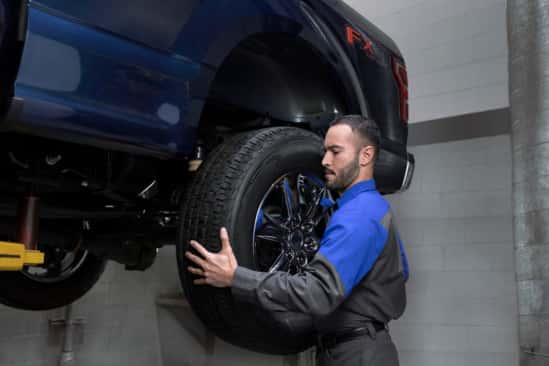
At 60,000 miles, Ford recommends inspecting the automatic transmission fluid and servicing it per the owner’s manual. For 4WD and AWD vehicles, front and rear axle fluids should also be inspected and replaced at this interval if the truck has been used for frequent towing, hauling, or off-road driving. The drive belt and tensioner should also be inspected at this milestone.
This is also the point where many owners delay service because the cost is higher than a routine oil change. The items at 60,000 miles, particularly the transmission fluid and drivetrain fluids, are what protect the most expensive components in the vehicle. Skipping or delaying this service to save money now often leads to significantly higher repair costs later.
For F-150 owners who tow regularly or haul heavy loads around Hempstead, Uniondale, or down into the boroughs, Ford’s severe duty schedule moves the axle and transfer case fluid intervals earlier. More on that in the next section.
100,000 Miles: Spark Plugs, Coolant, and Belts
This is the most comprehensive milestone in the standard schedule. Ford recommends the following at 100,000 miles:
- Spark plug replacement on most gasoline engines. Modern Fords use iridium or platinum-tipped plugs that last much longer than older copper plugs, but they do not last indefinitely. Worn spark plugs cause rough idle, reduced fuel economy, and in some cases misfires that trigger the check engine light. Replacing them on schedule is far cheaper than diagnosing the symptoms.
- Engine coolant replacement. Ford uses orange-colored extended-life coolant. The first coolant change is typically recommended at 100,000 miles, then every 50,000 miles after that. Coolant that has broken down loses its ability to prevent corrosion and regulate engine temperature effectively.
- Accessory drive belt inspection starting at 100,000 miles, with replacement recommended by 150,000 miles. The serpentine belt drives the alternator, power steering pump, and air conditioning compressor. A snapped belt leaves you stranded immediately. Belt replacement is inexpensive relative to a tow truck and the inconvenience of being stuck on the side of the Northern State Parkway.
150,000 Miles: Transmission and Drivetrain Fluids
Ford’s official interval for automatic transmission fluid change on normal-duty vehicles is 150,000 miles. At the same interval, transfer case fluid and front and rear axle lubricant are due for replacement. If you have been running the truck under severe duty conditions, these fluids should have been serviced much earlier, but for normal highway and suburban use, 150,000 miles is Ford’s published interval.
Normal Duty vs. Severe Duty: Which One Are You?
Ford defines normal duty as typical highway and suburban driving without frequent towing, hauling, or extreme conditions. Severe duty shortens several service intervals and applies to anyone who:
- Tows or hauls heavy loads regularly. For F-150 owners using the truck for work, pulling trailers to job sites in Mineola or Bethpage, or hauling materials on a regular basis, this is you.
- Makes frequent short trips under five miles, especially in cold weather. Cold starts and short trips that do not bring the engine to full operating temperature are harder on oil and drivetrain components.
- Operates in extreme temperatures, in dusty conditions, or off-road.
- Idles for extended periods, which applies to contractors who run the truck as a work platform with the engine on.
Under severe duty conditions, Ford shortens the following intervals: axle lubricant to every 30,000 miles, transfer case fluid to every 60,000 miles, and engine air filter replacement more frequently than the standard 30,000 miles. The oil-life monitor will naturally reflect severe use and call for more frequent oil changes without any adjustment on your part, since it is measuring actual conditions.
If you are unsure whether your driving qualifies as severe duty, the Ford maintenance schedule lookup tool at ford.com accounts for this when you enter your vehicle details.
Model Notes: F-150, Escape, Explorer, Bronco, and Maverick
F-150
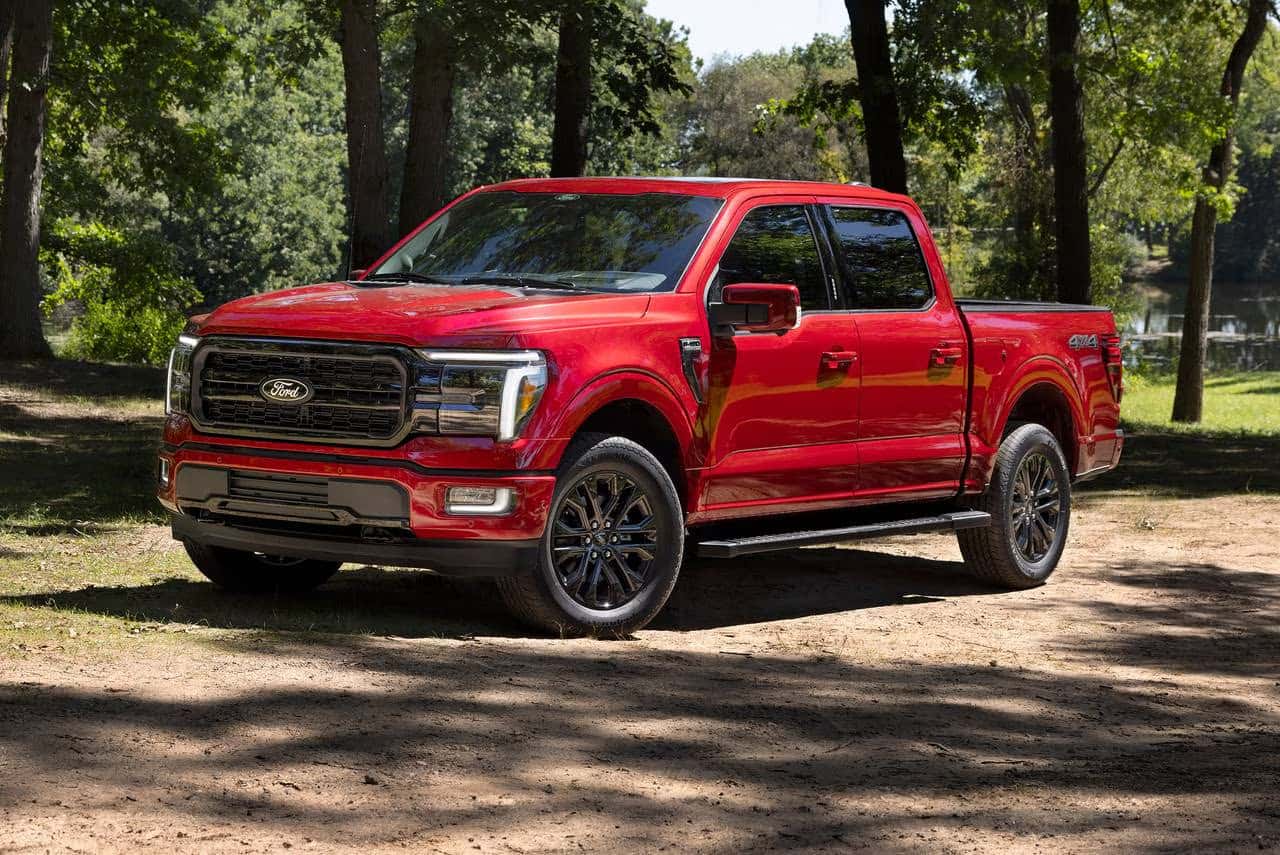
The Intelligent Oil-Life Monitor on the F-150 is particularly sensitive to towing and hauling. If you regularly pull a trailer or carry heavy loads in the bed, expect the wrench to appear more frequently. The 3.5L EcoBoost and PowerBoost Hybrid engines both require full synthetic oil meeting Ford’s WSS-M2C946-A specification. Using the wrong viscosity or oil type in a turbocharged engine is one of the more common causes of premature wear. Always confirm the spec with your service advisor before any oil change.
For 4WD F-150s, the front and rear axle lubricant is a commonly missed service item. Under severe use including regular towing, Ford recommends servicing axle fluids every 30,000 miles. Under normal use, the interval extends to 150,000 miles. Knowing which category applies to your truck matters.

Escape and Escape Hybrid
The Escape follows the standard schedule closely. The Hybrid version has a few additional considerations: the high-voltage battery cooling system requires periodic inspection, and brake wear patterns differ from a standard gas vehicle because regenerative braking does most of the work under normal deceleration. Physical brake pads tend to last longer on hybrids, but calipers can seize from infrequent use and should be inspected regularly.
Explorer
The Explorer’s engine air filter and transmission fluid intervals fall right on the standard schedule. Explorers doing a mix of highway and suburban stop-and-go driving, which describes most North Shore Explorers, tend to accumulate service needs without much deviation from the numbers above. The timing chain on the Explorer’s EcoBoost engines should be monitored. If you notice rough starts or unusual engine noise as mileage climbs, bring it in for an inspection.
Bronco
The Bronco, especially in configurations with the Sasquatch Package or any off-road use, needs more frequent differential and transfer case fluid checks than a standard SUV. If yours has been through standing water, mud, or rough terrain, Ford recommends checking those fluids immediately rather than waiting for the standard interval. Submersion can contaminate axle and transfer case fluid quickly.

Maverick
The Maverick Hybrid is one of the most fuel-efficient trucks on the market, but its hybrid drivetrain follows the same additional considerations as the Escape Hybrid including regenerative brake monitoring and battery cooling inspection. The standard EcoBoost Maverick follows the normal service schedule without exception.
After any service visit, you can also use your smartphone to track your maintenance history and set reminders so the next milestone does not sneak up on you.
Ford Protect Maintenance Plans: What Is Worth It
Ford offers prepaid maintenance plans under the Ford Protect umbrella. Here is the straightforward version of what they are and whether they make sense.
A prepaid maintenance plan locks in today’s labor and parts rates for future service visits. If you plan to keep the vehicle and stay on schedule, the math often works in your favor because service costs tend to rise over time. Plans are purchased at the time of the vehicle sale or shortly after, and they cover scheduled maintenance items only, not repairs.
- What is worth including: oil changes, tire rotations, and multi-point inspections. These are the services you will definitely need and the ones where prepaying provides the most predictable value.
- What to evaluate carefully: plans that include services you may not reach within the coverage period. If you drive 8,000 miles a year and a plan covers services through 45,000 miles over five years, confirm the math works for your actual usage before committing.
- Added benefit: the plans are transferable if you sell the vehicle, which adds measurable value at resale. They are also honored at any Ford dealer nationwide, so if you are in service at another location while traveling, you are covered.
If you have questions about what is currently available for your specific vehicle, the service team at Biener Ford can walk you through the options during your next visit.
FAQ: Ford Service Intervals
What does the orange wrench light mean on a Ford?
The orange wrench icon is the Intelligent Oil-Life Monitor telling you an oil change is due soon. It is a scheduled maintenance reminder, not an emergency. Your oil life percentage has dropped to around 15%. You have some time but should schedule a service visit within the next one to two weeks.
How does Ford’s Intelligent Oil-Life Monitor work?
It tracks engine temperature, RPM, load, idle time, and driving conditions to calculate how much useful life the oil actually has remaining. It does not use a fixed mileage counter. The interval varies depending on how you drive, which makes it more accurate than a mileage sticker.
What is the difference between the wrench light and the oil can light?
The wrench is a maintenance reminder telling you an oil change is due soon. The oil can is an active warning telling you oil pressure is critically low right now. The oil can requires you to stop driving as soon as safely possible. Keep driving with low oil pressure and you risk serious, potentially irreversible engine damage.
How often should I change the oil in my Ford F-150?
The Intelligent Oil-Life Monitor tells you based on your actual driving conditions. For most F-150 owners the interval falls somewhere between 7,500 and 10,000 miles under normal conditions. Towing and hauling regularly will shorten that interval. Ford also recommends a maximum of one year between oil changes regardless of the monitor reading.
What does Ford recommend at 30,000 miles?
At 30,000 miles, the engine air filter is due for replacement. This is in addition to the standard oil change, tire rotation, and multi-point inspection. Ford recommends inspecting the cooling system, exhaust system, braking system, and suspension at this interval as well.
What happens at 60,000 miles on a Ford?
Automatic transmission fluid inspection and service per the owner’s manual, front and rear axle fluid replacement for towing and hauling trucks, and drive belt and tensioner inspection. This is typically the most expensive service interval up to that point. Staying on schedule protects the most expensive components in the vehicle.
What happens at 100,000 miles on a Ford?
Spark plug replacement on most gasoline engines, engine coolant replacement, and accessory drive belt inspection with replacement recommended by 150,000 miles. This is the most comprehensive milestone in the standard schedule.
Does the Ford service schedule differ for severe duty use?
Yes. Severe duty applies to frequent towing and hauling, short trips in cold weather, off-road use, and extended idling. Under severe conditions, axle lubricant intervals shorten to every 30,000 miles and transfer case fluid to every 60,000 miles. The oil-life monitor will automatically reflect harder use by calling for more frequent oil changes.
Where can I find my Ford’s official maintenance schedule?
Ford’s official maintenance schedule lookup tool is at ford.com/support/maintenance-schedule. Enter your VIN or vehicle details and it returns the manufacturer-recommended schedule specific to your year, model, and engine.
Where can I get my Ford serviced near Garden City or the North Shore?
Biener Ford in Great Neck is located at 661 Northern Blvd and serves drivers from Garden City, Roslyn, Manhasset, Port Washington, New Hyde Park, and across Nassau. Schedule a service appointment online or contact the team directly to book your visit.

Schedule Ford Service at Biener Ford
If your Ford is due for maintenance, the Biener Ford team is here to help you stay on schedule and understand what your vehicle actually needs. Whether you are coming in for your first oil change, a 60,000-mile service, or help diagnosing a dashboard message, we are ready to walk you through it.
Need Ford Service?
From oil changes and tire rotations to major milestone maintenance, Biener Ford is here to help keep your Ford running the way it should.

0 comment(s) so far on Ford Service Intervals Explained: When Does Your Ford Actually Need to Come In?