
Ford Lightning vs. Ford F-150
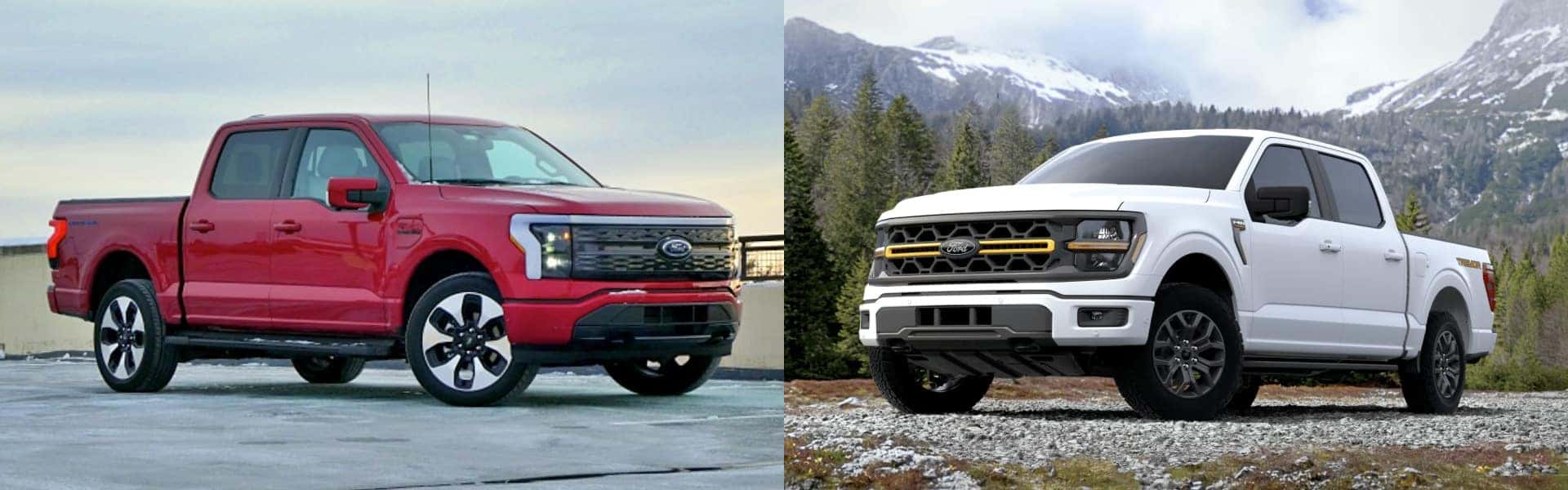
On the North Shore, an area known for its hardworking community, everyday heroes are everywhere. They’re the people who keep our cities going, balancing tough jobs and family life effortlessly. For these dedicated individuals, having a reliable and efficient vehicle is crucial—it’s a key part of their daily lives. This is where the Ford F-150 Lightning comes in, offering a fresh perspective on what vehicles can do for these heroes.
The Ford F-150 has always been a popular choice among these workers, renowned for its durability, dependability, and flexibility. Now, the electric version, the F-150 Lightning, is ready to make its mark. We’re about to dive deep into how the F-150 Lightning measures up against its traditional counterpart, particularly for those who know and trust the Ford truck lineup.
Section 1: Pricing
When it comes to buying a Ford F-150, price plays a big role. The all-electric F-150 Lightning starts at $62,995 for the XLT model, while the more upscale versions like the FLASH, LARIAT, and Platinum can go as high as $84,995. On the other hand, the traditional gasoline-powered F-150 has a wider price range starting at $36,770 for the XL model, and ranging to $78,330 for the epic Ford Raptor model.
For potential buyers in the Northeast, evaluating the F-150 Lightning means looking beyond just the initial price tag to consider long-term savings. Electric vehicles (EVs), such as the Lightning, tend to have lower operating costs over time thanks to savings on fuel and maintenance. Additionally, buyers should factor in incentives and subsidies, like federal tax credits or state-specific benefits, which can significantly lower the overall cost of owning an EV.
For the most current and detailed pricing, incentives, and subsidy information, please contact Biener Ford or visit our website.
Section 2: Towing
When we look at towing, both the electric and gasoline versions of the Ford F-150 show off their strengths, from hauling construction materials to performing farm duties. The traditional gasoline F-150 is famous for its strong towing ability. Some models can tow up to 13,500 pounds, making it great for carrying heavy work gear or large boats and trailers over tough terrain.
On the other hand, the F-150 Lightning, Ford’s electric version, also impresses by matching many of the gasoline model’s towing capabilities, which is quite an achievement for an electric truck. It can tow up to 10,000 pounds when it has the right setup with the extended-range battery and Max Trailer Tow Package. This makes the Lightning a good fit for towing smaller boats, trailers, and mid-sized campers. It’s especially appealing to those who care about the environment or want to save on fuel costs in the long run.
For people living in Long Island, where towing might mean moving materials across town or hauling equipment to nearby job sites, the F-150 Lightning offers plenty of power without the pollution. Considering the usual towing needs in urban and suburban areas, the F-150 Lightning stands out as a solid option, providing the dependability and performance expected from the F-Series, plus the benefits of electric vehicle technology.
Section 3: Range and Mileage
When comparing the range of the F-150 Lightning to that of the traditional gasoline-powered F-150, it’s important to consider the needs of everyone, from those taking short city drives to those traveling longer distances across the state. The range of the traditional F-150 depends on the size of the gasoline tank and the type of engine, but EPA reports 18 MPG in the city and 23 MPG on the highway.
The F-150 Lightning introduces a significant change with its all-electric powertrain. The standard-range battery provides an EPA-estimated range of about 240 miles, while the extended-range battery ups this to around 320 miles on a single charge. This range is more than adequate for daily commutes and frequent trips in urban and suburban areas. For those thinking about switching to an electric truck, the F-150 Lightning not only meets most daily travel needs but also adds the convenience of home charging, which means fewer trips to the gas station.
Additionally, the F-150 Lightning is more mileage-efficient compared to gasoline engines. This efficiency translates into estimated fuel cost savings of $4,250 over 5 years and a smaller carbon footprint. With that, the MPGe range of the Lightning almost triples the gas-powered counterpart, with 78 MPGe in the city and 63 MPGe on the highway. Therefore, the F-150 Lightning offers a strong option for both daily commuting and regular travel in and around the Greater New York area.
Section 4: Storage Space
When comparing the cargo and storage options of the Ford F-150 Lightning with the traditional F-150, both trucks offer strong features that meet both the work and personal needs of people in and around the city. The traditional F-150 is well-known for its flexible bed options and interior compartments, making it great for carrying everything from building materials to camping gear for a family trip.
The F-150 Lightning introduces a new feature that the gasoline model doesn’t have: a spacious front trunk, or “frunk.” This secure, weatherproof area adds about 14 cubic feet of extra storage that’s easy to get to and can be locked. It’s really useful for keeping tools or groceries safe, offering an extra layer of convenience for city drivers who might need more secure storage separate from the main cargo area.
Section 5: Performance
The power and performance of the F-150 Lightning compared to the traditional gasoline F-150 are important for drivers in and around the city. The electric F-150 Lightning offers instant torque, which means it can speed up quickly (0-60 in under 4 seconds), and it provides a smooth, quiet ride. This makes it perfect for busy city streets and fast highway driving. It delivers up to 580 horsepower and 775 lb-ft of torque, ensuring strong performance in different driving conditions.
The traditional gasoline F-150 provides a variety of power outputs depending on the engine type, giving drivers a more classic feel with varying horsepower and torque. The 2.7L EcoBoost engine delivers 325 horsepower along with 400lb.-ft of torque. The 3.5L version comes in with a whopping 400 horsepower and 500 lb.-ft of torque. However, the quick response and quieter operation of the electric F-150 make it particularly appealing for city driving, where you often need to accelerate quickly and handle the car with precision.
Section 6: Safety
Both the Ford F-150 Lightning and the traditional gasoline F-150 make safety a top priority, incorporating advanced features to protect drivers on the busy Great Neck streets. The F-150 Lightning brings in specific safety improvements related to its electric design, such as a lower center of gravity because of where the battery is placed. This lowers the risk of the truck rolling over. It also comes equipped with Ford’s Co-Pilot360™ technology, which includes automatic emergency braking and lane-keeping assist.
The traditional gasoline-powered F-150 is similarly outfitted with Ford’s safety technology and has been recognized for its solid build and reliable safety features in crash tests. While both models offer strong safety packages, the F-150 Lightning adds extra benefits that are specific to electric vehicles, making it a particularly appealing choice for drivers who are very conscious about safety in busy urban areas.
The Ford F-150 Lightning stands out as a top choice, offering a great mix of power, efficiency, and advanced technology. It boasts strong towing abilities, a long electric range, creative storage options, powerful performance, and improved safety features. The F-150 Lightning is perfect for those who need a high-performing truck but also care about the environment. Whether you choose the electric Lightning or the traditional gasoline F-150, you can’t go wrong with either option. To explore these exceptional trucks, visit Biener Ford and see how the F-150 Lightning can transform your daily driving experience.

0 comment(s) so far on Ford Lightning vs. Ford F-150