
Ford Hybrid Trucks: What the F-150 PowerBoost Hybrid Does and Whether It’s Right for You
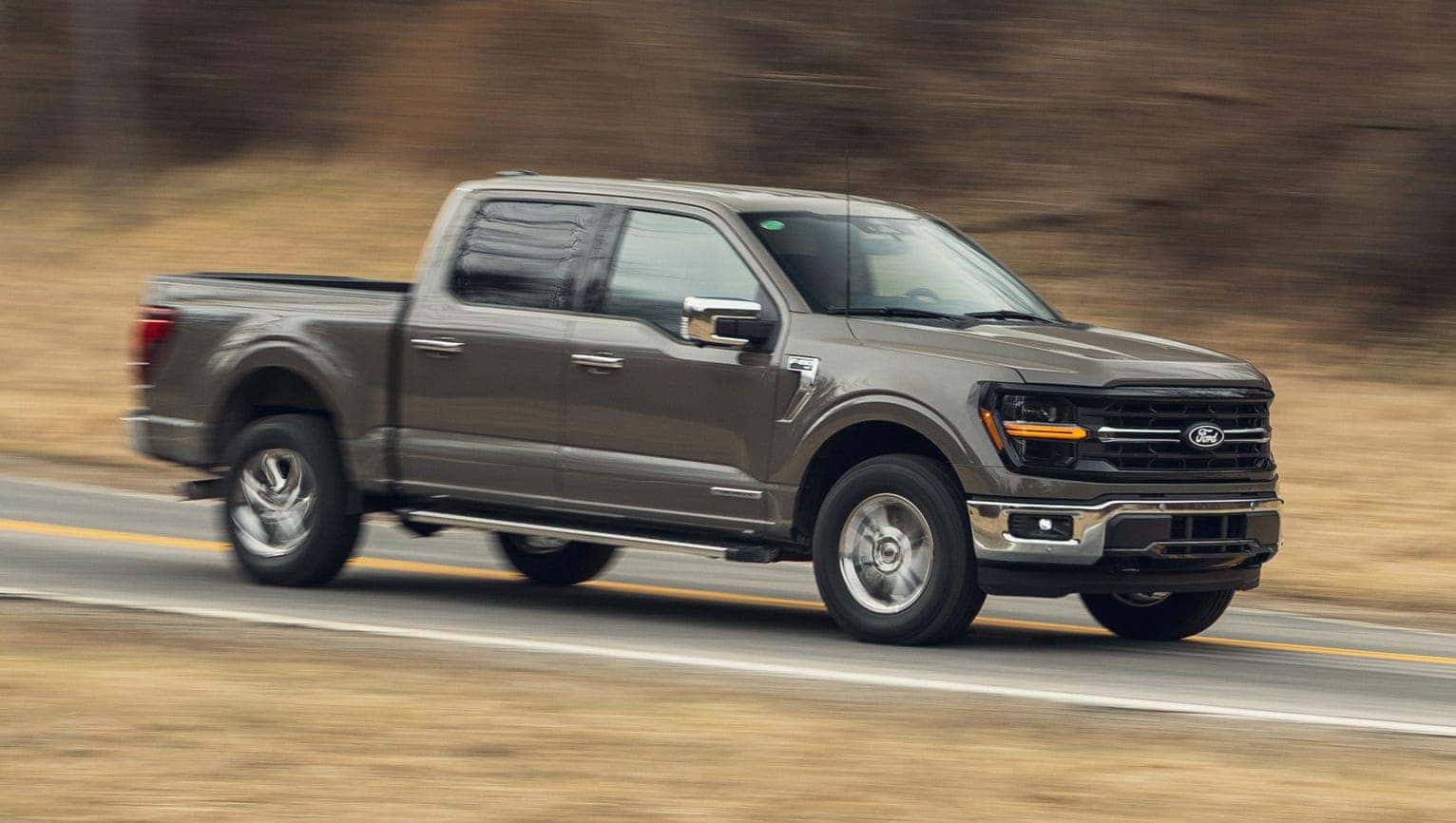
Ford Hybrid Trucks: What the F-150 PowerBoost Hybrid Does and Whether It’s Right for You
The F-150 PowerBoost has been around long enough that most contractors have heard of it. Fewer know exactly what it does. It is not a plug-in hybrid. You never charge it. It does not give up towing capacity for fuel savings. And it comes with a built-in generator that can replace a separate unit on a job site.
This post explains what the PowerBoost system is, what it costs over a standard F-150, and whether it makes sense for a Long Island contractor or commuter who is ready to decide.
Index
- Ford Hybrid Trucks: What the F-150 PowerBoost Hybrid Does and Whether It’s Right for You
- What the PowerBoost System Is
- Fuel Economy: Real Numbers for Long Island Driving
- Pro Power Onboard: The Feature That Changes the Job Site
- Towing and Payload: What Changes and What Does Not
- Which Trims Offer the PowerBoost
- What the Price Premium Looks Like and When It Pays Off
- Does the PowerBoost Require Special Maintenance?
- Is the PowerBoost Right for You?
- FAQ: Ford F-150 PowerBoost Hybrid
What the PowerBoost System Is
The F-150 PowerBoost is a full hybrid system. That is different from a mild hybrid, which only assists the engine and cannot move the vehicle on electricity alone. The PowerBoost can. At low speeds and light loads, it runs on the electric motor with the gas engine off. When you need more power, the gas engine joins in. The transition happens automatically without any input from the driver.
The system pairs a 3.5-litre twin-turbocharged V6 with a 35-kilowatt electric motor built into the 10-speed automatic transmission. A 1.5 kilowatt-hour lithium-ion battery pack sits under the cab floor and is liquid-cooled, which matters for sustained use under load like running the Pro Power Onboard generator for hours at a time.
Combined output is 430 horsepower and 578 lb-ft of torque. The torque figure is the highest in the standard F-150 lineup and arrives immediately from a stop because of how electric motors work. For a contractor loading up in Melville and merging onto the LIE at 6:30 in the morning, that low-end response is noticeable compared to a standard gas engine.
One thing to know before going further: the PowerBoost is only available on the SuperCrew cab. If you need a Regular Cab or SuperCab, this engine is not an option.
Fuel Economy: Real Numbers for Long Island Driving
The 2026 F-150 PowerBoost 2WD is EPA-rated at 23 city, 25 highway, and 24 combined MPG on regular gasoline. Ford estimates an annual fuel cost of $2,550 based on 15,000 miles per year at current prices.
| Engine | City MPG | Highway MPG | Combined MPG |
|---|---|---|---|
| 2026 F-150 PowerBoost 2WD | 23 | 25 | 24 |
| 3.5-litre EcoBoost 4WD | Around 17 | Around 23 | — |
| 5.0-litre V8 | 16 | 24 | — |
The PowerBoost’s biggest efficiency advantage shows up in city and stop-and-go driving. The hybrid system captures energy during braking and coasting and uses it to recharge the battery. Every stop on the Northern State, every merge on the LIE, every crawl through Melville at 8 AM contributes energy back into the system rather than being wasted as heat. On a long open highway run at 70 miles per hour, the efficiency gap between the PowerBoost and a standard engine gets smaller.
In real-world mixed Long Island driving, most owners see between 19 and 23 MPG depending on how much highway versus local driving is involved and how heavily the truck is loaded. Under heavy towing, fuel economy drops to roughly 14 to 18 MPG, similar to the standard 3.5-litre EcoBoost under the same conditions.
Pro Power Onboard: The Feature That Changes the Job Site
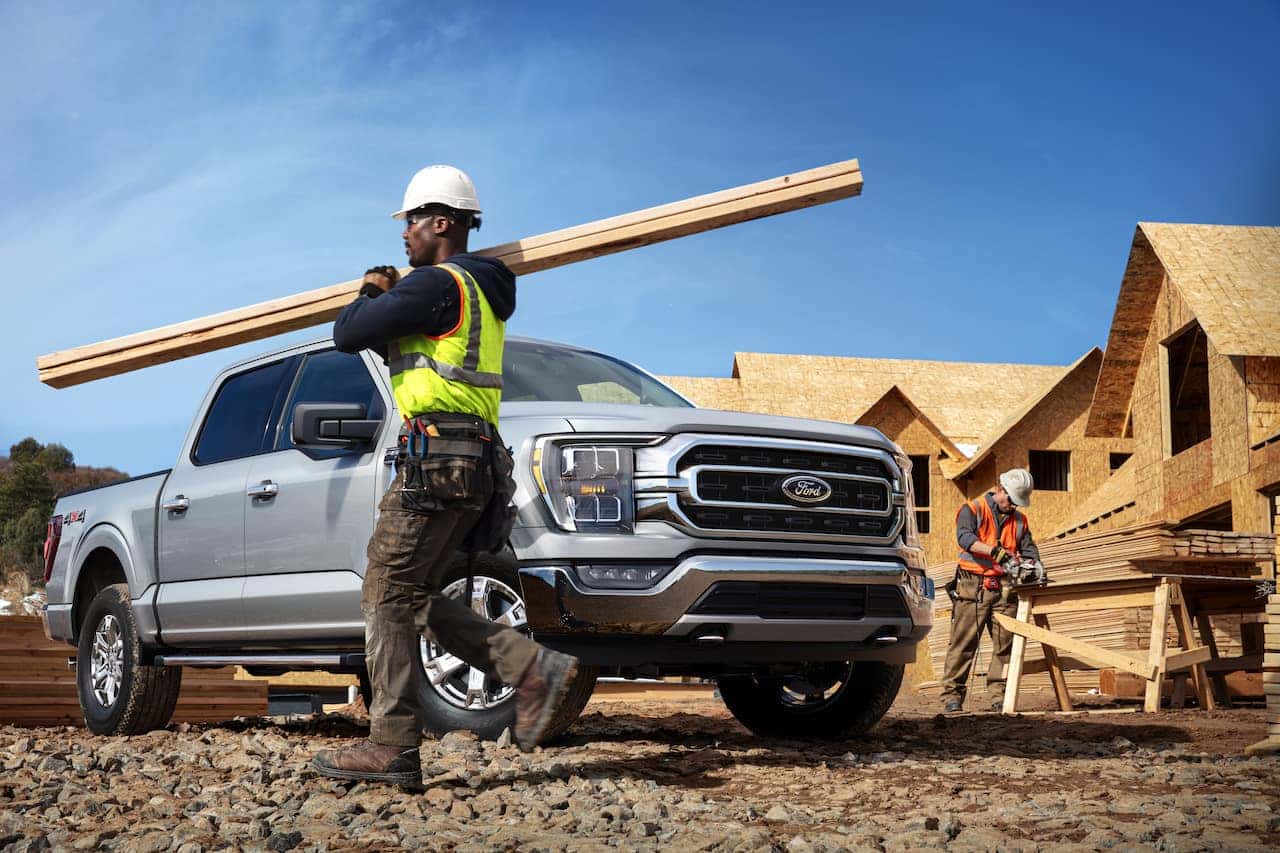
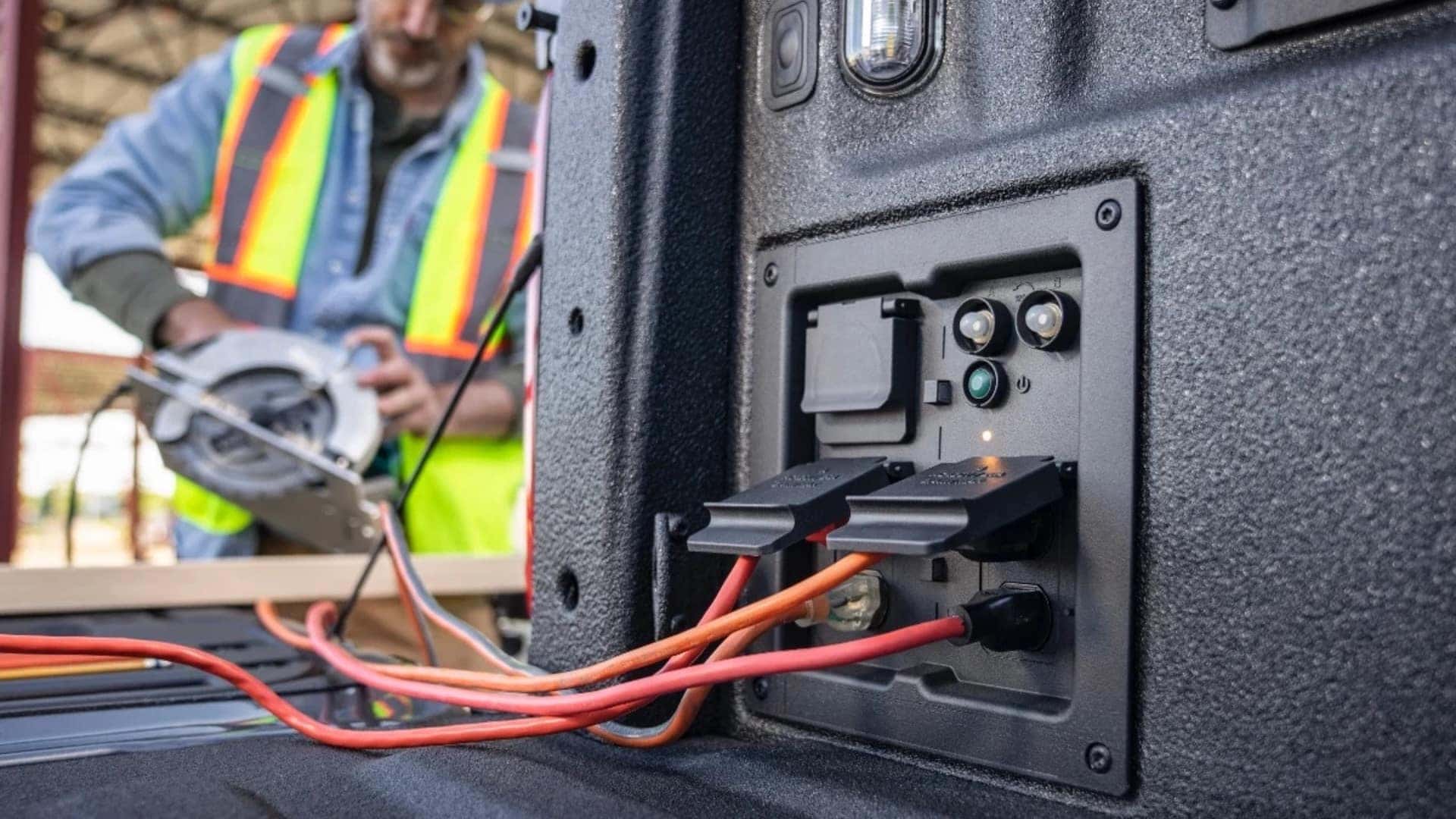
Pro Power Onboard is the feature that converts most contractors from curious to committed. It uses the hybrid system to deliver standard 120-volt power through outlets in the truck bed and cab, the same outlets you would find on a wall at home or in a shop.
Every PowerBoost model comes with 2.0 kW of Pro Power Onboard as standard. The 7.2 kW system is available as an upgrade on STX, XLT, Lariat, and King Ranch trims, and comes standard on the Platinum Plus.
| Pro Power System | Typical Use |
|---|---|
| 2.0 kW | One or two basic tools at a time, including a drill, skill saw, lights, phones, and tablets. |
| 7.2 kW | Multiple job-site tools simultaneously, with capacity remaining for lights, chargers, and other equipment. |
A 2.0 kW system handles one or two basic tools at a time: a drill, a skill saw, a light, charging phones and tablets. It covers the essentials but hits its limit quickly if you are running multiple tools at once.
A 7.2 kW system runs a full job site. A circular saw draws about 1.5 kW. An angle grinder draws about 1.0 kW. A reciprocating saw draws about 1.1 kW. Running all three at the same time uses roughly 3.6 kW, leaving room for lights, chargers, and other equipment. Most site compressors start high and then settle to a lower sustained draw that the 7.2 kW system handles without trouble.
For a Melville contractor whose crew currently hauls a separate 6,500-watt gas generator to every job, the 7.2 kW Pro Power Onboard system replaces it entirely. No trailer, no separate fuel, no startup routine, no maintenance on a second piece of equipment. The truck provides the power.
The system runs quietly at low draw. At higher sustained loads it runs the engine to keep up, but much more quietly than a standalone gas generator. On a residential job site in Commack or Dix Hills where noise matters, that difference is real.
Using Pro Power Onboard During a Home Outage
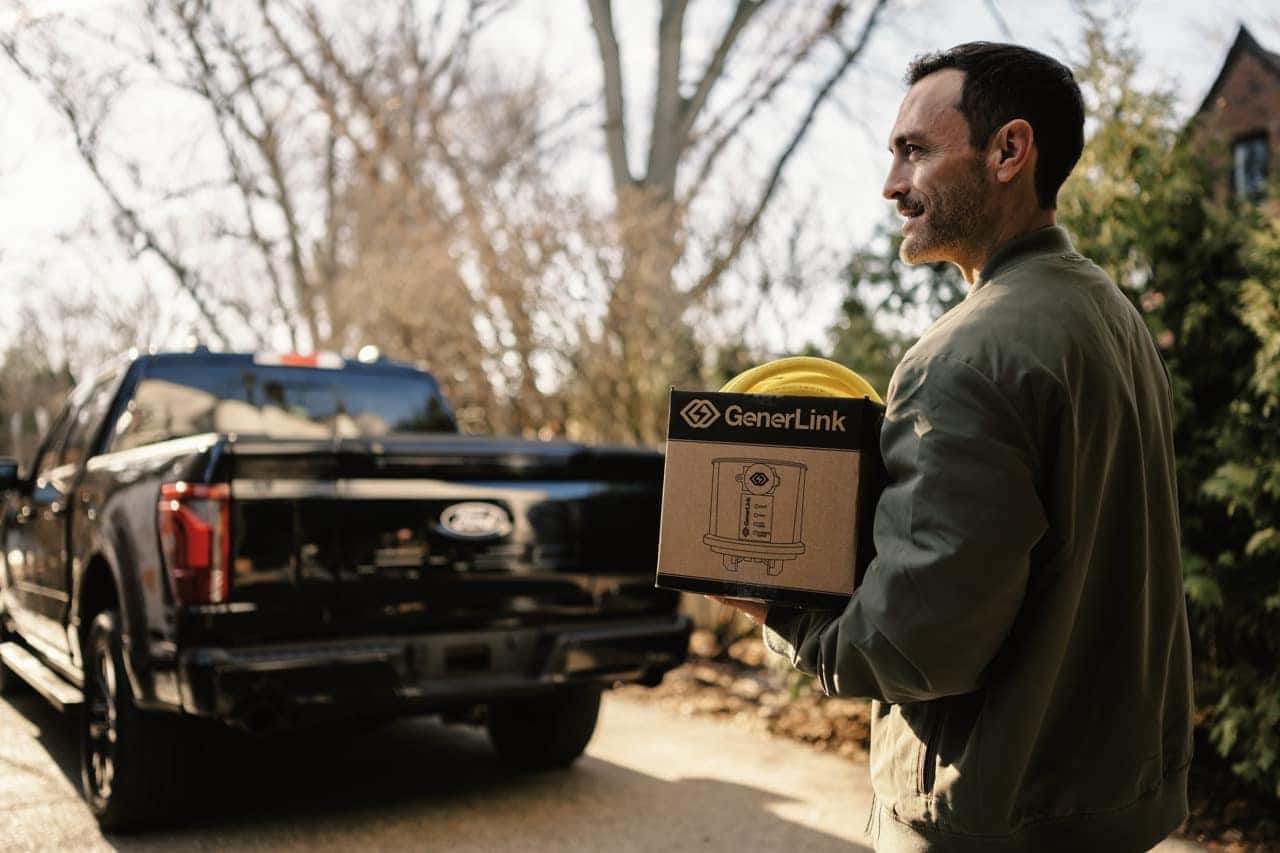
If you want to use the 7.2 kW system to power your home during a storm outage, you need a GenerLink transfer switch installed by a licensed electrician. The truck’s outlets cannot connect directly to your home’s electrical panel without it. With the transfer switch installed, the truck can power essential circuits during an outage. Without it, you power devices directly from the truck’s outlets.
Towing and Payload: What Changes and What Does Not
The F-150 PowerBoost tows up to 12,400 lbs when properly equipped with the 4×4 SuperCrew, 157.2-inch wheelbase, 3.73 axle ratio, and the Max Tow Axle option. Standard 4×4 configurations without the Max Tow Axle range from 10,800 to 11,600 lbs depending on wheelbase and axle ratio. Maximum payload is 1,740 lbs.
For most Long Island contractors, those numbers cover the job. A fully loaded enclosed trailer, a skid steer, a landscape trailer with equipment, a boat for summer: all of these fall well under 12,400 lbs. The tasks that push beyond that ceiling are less common in typical contractor use.
Payload at 1,740 lbs is slightly lower than the maximum available on some standard F-150 builds. If you regularly haul materials near the maximum payload limit, confirm this against your specific loads before deciding on the PowerBoost.
The concern some buyers have that a hybrid truck is somehow less capable than a standard gas truck does not hold up against the numbers for most real-world use.
Which Trims Offer the PowerBoost
The PowerBoost is available on five 2026 F-150 trims:
| 2026 F-150 Trim | Starting Price |
|---|---|
| STX | $41,855 |
| XLT | $44,695 |
| Lariat | $59,560 |
| King Ranch | $65,825 |
| Platinum | $68,800 |
It is not available on the XL, Tremor, or Raptor.
XLT is the starting point for most work truck buyers who want the PowerBoost. It includes the 2.0 kW Pro Power Onboard as standard and the option to upgrade to 7.2 kW. If the truck also serves as a daily driver, the Lariat adds comfort and technology features that make a difference when you spend several hours a day behind the wheel. If 7.2 kW Pro Power Onboard is the main reason you are looking at the PowerBoost, confirm the upgrade is included or priced in when you configure.
What the Price Premium Looks Like and When It Pays Off
The PowerBoost typically costs $4,000 to $5,000 more than the equivalent standard 3.5-litre EcoBoost trim. The exact number depends on trim level and current Ford incentives, which change monthly. The Biener Ford team can pull current pricing and any available financing offers on PowerBoost inventory.
Fuel savings alone do not recover the premium quickly. At $600 to $700 per year, paying back a $4,500 premium through fuel savings takes six to seven years.
Where the Value Calculation Changes
A separate 6,500-watt gas generator costs $800 to $1,500 to buy, plus ongoing fuel, maintenance, and eventual replacement. For a contractor who hauls one to every job, eliminating that equipment changes the numbers. If the 7.2 kW system replaces a generator you were going to buy or replace anyway, the net cost premium drops significantly.
The PowerBoost also holds its value well in the used truck market. Hybrid trucks are increasingly popular in used truck searches, which tends to support stronger resale values compared to the same truck with a standard engine.
Does the PowerBoost Require Special Maintenance?
Not in any meaningful way. The PowerBoost follows the same scheduled maintenance intervals as the standard 3.5-litre EcoBoost for oil changes and other routine service. Ford’s Intelligent Oil-Life Monitor calculates oil change timing based on how the truck is driven rather than a fixed mileage schedule.
The regenerative braking system reduces wear on the physical brake pads because the electric motor handles part of the braking load. Brake pad replacement intervals tend to run longer on the PowerBoost than on a non-hybrid F-150.
The lithium-ion battery is sealed and liquid-cooled. It requires no maintenance from the owner. The hybrid system is covered under Ford’s standard powertrain warranty.
Staying current on software updates is worth doing. Ford has released several updates for the PowerBoost system since its launch that improve performance and address issues flagged in early production. These are handled during regular service visits at Biener Ford.
Is the PowerBoost Right for You?
You bring a generator to job sites
For a Long Island contractor who currently hauls a separate generator to every job, the 7.2 kW Pro Power Onboard system makes a clear case on its own. The fuel savings help. The generator replacement value is the stronger argument. For a contractor in Melville who spends money on generator fuel and maintenance every week, the math gets to yes quickly.
Fuel economy is your only priority
For a buyer evaluating the PowerBoost purely on fuel economy with no generator use case, the premium is harder to justify on savings alone. The standard 2.7-litre EcoBoost delivers solid efficiency at a lower price and may be the smarter choice if the generator capability is not something you need.
You split time between work and commuting
For a buyer who does a mix of job site work and commuting across Nassau and Suffolk Counties, the PowerBoost covers both. Better fuel economy in Long Island stop-and-go traffic and a generator on the job. That is the combination where it makes the most sense.
FAQ: Ford F-150 PowerBoost Hybrid
Is the F-150 PowerBoost a plug-in hybrid?
No. The PowerBoost is a full hybrid that charges its own battery through regenerative braking and the gas engine. You never plug it in. You fuel it with regular gasoline the same as any other F-150.
What is the fuel economy of the 2026 F-150 PowerBoost?
The 2026 F-150 PowerBoost 2WD is EPA-rated at 23 city, 25 highway, and 24 combined MPG on regular gasoline. Ford estimates an annual fuel cost of $2,550 based on 15,000 miles per year at current prices.
What is Pro Power Onboard and what can it run?
Pro Power Onboard delivers standard 120-volt power through outlets in the truck bed and cab using the hybrid system. The standard 2.0 kW system handles basic tools and charging. The 7.2 kW upgrade runs a full complement of job site tools simultaneously. Powering a home during an outage requires a GenerLink transfer switch installed separately by a licensed electrician.
How much can the F-150 PowerBoost tow?
Up to 12,400 lbs when properly equipped with the 4×4 SuperCrew, 157.2-inch wheelbase, 3.73 axle ratio, and Max Tow Axle option. Standard 4×4 configurations range from 10,800 to 11,600 lbs depending on wheelbase and axle ratio.
Does the PowerBoost cost more than a standard F-150?
Yes, approximately $4,000 to $5,000 more than the equivalent standard 3.5-litre EcoBoost trim. Current pricing and incentives change monthly. Contact the Biener Ford team for current figures.
Does the PowerBoost need different maintenance?
No significant differences. Oil changes follow Ford’s Intelligent Oil-Life Monitor. The regenerative braking system reduces physical brake wear. The hybrid battery is sealed and requires no owner maintenance. Staying current on software updates through Biener Ford service visits is recommended.
Which F-150 trims offer the PowerBoost for 2026?
STX, XLT, Lariat, King Ranch, and Platinum. Not available on XL, Tremor, or Raptor. XLT is the practical entry point at $44,695. The 7.2 kW Pro Power Onboard upgrade is available on all PowerBoost trims and standard on Platinum Plus.
Where can I drive the F-150 PowerBoost on Long Island?
Biener Ford in Great Neck serves drivers from Melville, Commack, Syosset, Mineola, and across Nassau and Suffolk Counties. View current F-150 inventory or contact the team to schedule a test drive.
See the Ford F-150 PowerBoost at Biener Ford
Explore current Ford F-150 inventory or contact the Biener Ford team in Great Neck to learn more about PowerBoost-equipped trucks.

0 comment(s) so far on Ford Hybrid Trucks: What the F-150 PowerBoost Hybrid Does and Whether It’s Right for You